

This is why you daytrade IPOs, not invest in them.
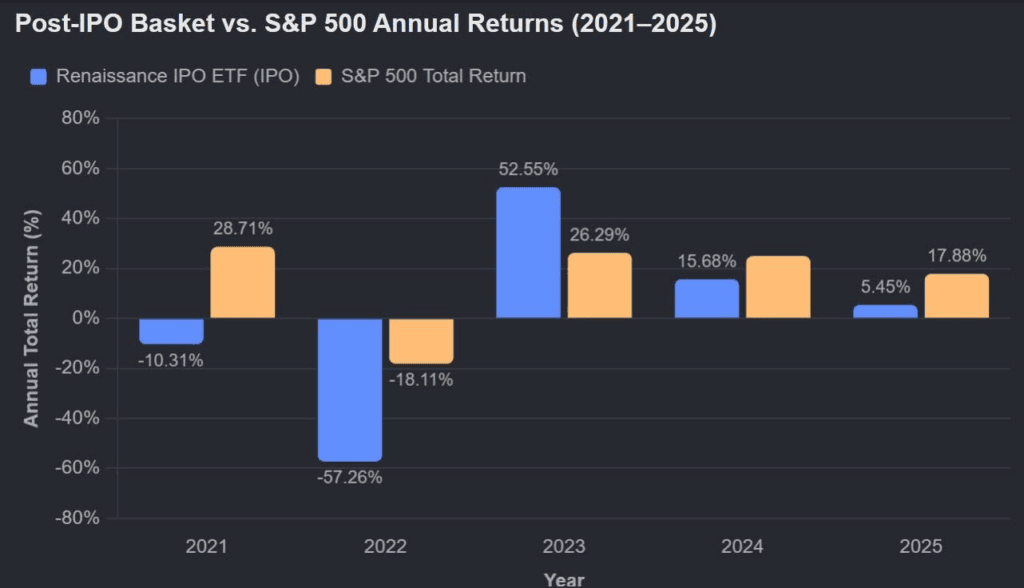
Unless you are investing in them early stage as a registered investor, insider, employee, etc, you have no business buying this stuff. Aggressive initial valuations are a primary driver for their underperformance (this means they tell you it’s worth more than it really is before going public). Most of the explosive, early-stage wealth is already captured in private markets before everyday investors get a chance to buy. People like to compare Apple, Amazon, etc., to these, but when Apple went public in 1980 at $1.8 billion valuation and Amazon went public in 1997 at $438 million valuation, they were still very small, high-growth businesses.
Regular investors could buy shares on the open market and ride decades of massive expansion. But again, this is no longer the case.
In the 80s and 90s, startups had to go public quickly to raise money for factories, servers, and expansion. Today, trillion-dollar private equity and venture capital funds supply all the cash a company needs privately.
So basically, if you get into these, you are what is called “exit liquidity for the rich.” I hope none of you had to learn this the hard way. Does this mean there is no way to make money? Absolutely not. Regular investors can still build long-term wealth in public markets through two main paths:
1. Waiting for the Post-IPO Dip (6-18 months).
2. Small and mid-cap companies that go public earlier at valuations between $500 million and $5 billion can still offer a road for growth if they do well over 5 to 10 years. Again IF.
3. Major indexes long term dollar cost averaging, set and forget, tried and true.
That is pretty much it for that world. I still prefer a nice real estate portfolio due to how accessible it is in comparison to private equity. The growth is a lot slower, though, but over time…. Well, you’ve seen the price of houses today right?